AI Summary
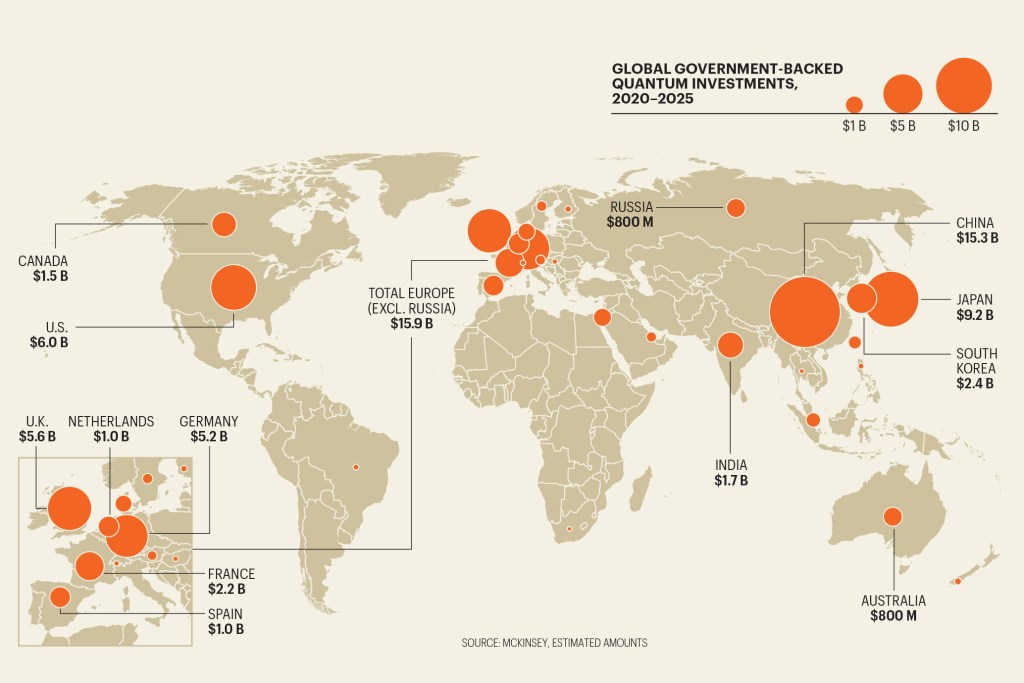
Europe has committed $15.9 billion to quantum technologies by 2025 in an effort to become a leader in the field. With significant investments and a strong startup ecosystem, the region aims to leverage its historical strengths in quantum research to capture a share of a market projected to generate $2.7 trillion by 2035.
- In 2017, a Google researcher highlighted significant challenges in quantum computing, particularly error correction.
- Riverlane, a startup founded in Cambridge, has developed a low-latency quantum error-correction system, employing nearly 200 people and collaborating with over 60% of global quantum computer manufacturers.
- The European Commission's Quantum Europe Strategy aims for Europe to become a global quantum leader by 2030, with McKinsey estimating the technology could create $2.7 trillion in economic value by 2035.
- Europe hosts 32% of the world's quantum companies and has a strong foundation in quantum research, with historical contributions from notable physicists.
- Despite significant public funding, private investment in European quantum startups is limited, with U.S. companies attracting the majority of global funding.
- European nations have committed $15.9 billion to quantum technologies, while U.S. federal funding reached about $8 billion, including recent increases.
- European startups face challenges in funding, leading some to seek capital in the U.S. market.
- The U.S. and China currently lead in quantum computing capabilities, with IBM and Google at the forefront.
- Quantum technology has potential applications in national security, including advanced navigation systems and breaking encryption.
- Europe may have an advantage in supplying critical components for quantum computers, which could position it favorably in the global technology landscape.
quantum computingemerging technologyeuropeai revolutioninvestment