Large Language Models
Nov 15, 2026
Exploring Positional Embeddings in Large Language Models
Nov 15, 2026
AI Summary
The article provides an in-depth examination of how large language models (LLMs) utilize positional embeddings to encode token position information. It covers various methods, including relative positional embeddings (RoPE) and discusses their relevance in modern LLM architectures.
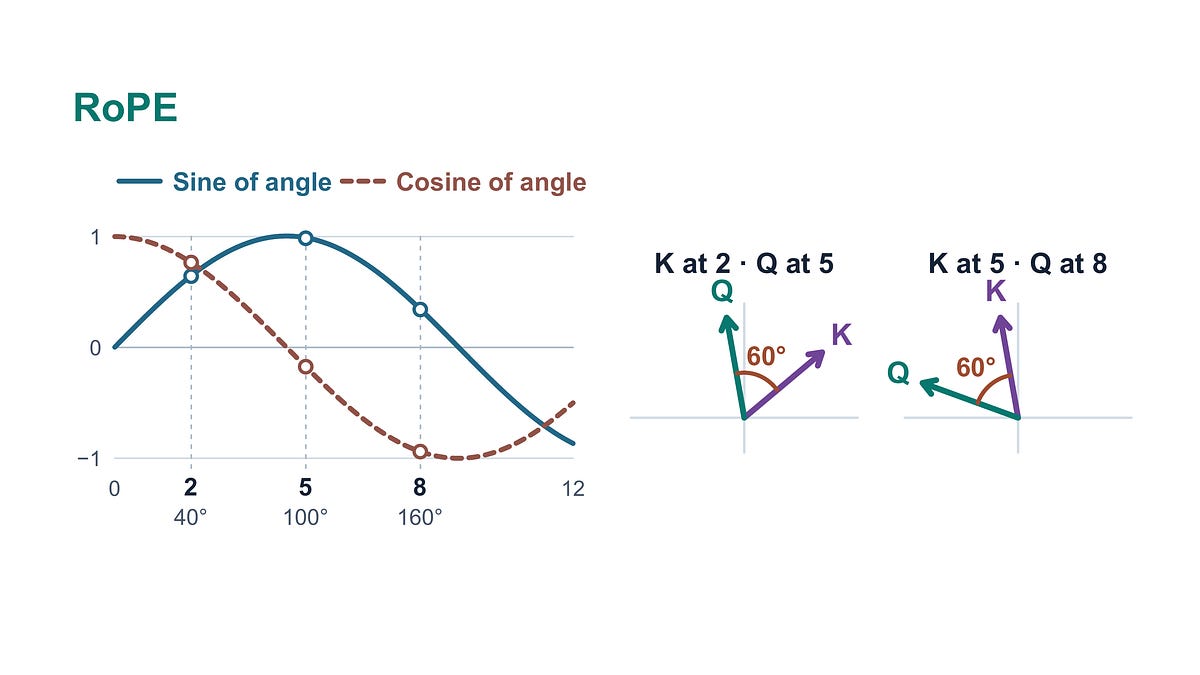
- The article discusses the encoding and processing of token position information in LLMs, focusing on both classic and contemporary methods, including RoPE.
- It highlights the importance of positional embeddings in distinguishing token meanings based on their order in sentences, using examples to illustrate the concept.
- The piece outlines the architecture of LLMs, explaining how token embedding layers and positional information are integrated before the transformer blocks.
- It compares the positional encoding methods used in different models, such as GPT-2 and MiniMax-M3, noting that GPT-2 uses absolute positional vectors while MiniMax-M3 employs RoPE.
- The article also addresses the implications of extending context lengths in positional embeddings and the computational costs associated with larger models.
- Additionally, it explains the historical context of positional encoding methods, referencing the original transformer architecture's use of fixed sine and cosine functions for position vectors.
positional embeddingsllmsmachine learningnatural language processingdeep learning