AI Business
2d ago
Offshore Call Center Employment Grows Despite AI Adoption in U.S. Companies
May 17, 2026
AI Summary
Despite the increasing use of AI in customer service roles, employment in offshore call centers, particularly in the Philippines, continues to rise. Economists suggest that AI may enhance productivity and demand for these roles rather than displace them, reflecting a complex relationship between technology and labor markets.
- In September 2025, Salesforce CEO Marc Benioff announced a reduction of 4,000 customer service roles, with remaining staff sharing duties with AI agents.
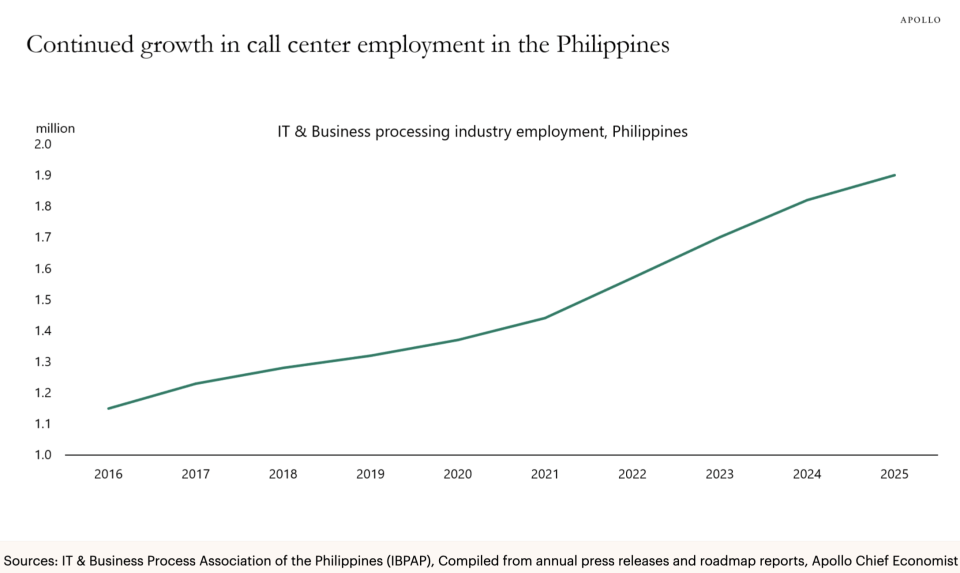
- Call center employment in the Philippines has nearly doubled from 2016 to 2025, reaching around 2 million workers, according to the IT & Business Process Association of the Philippines.
- Unemployment rates in the Philippines decreased from 9% to about 4% between 2021 and March 2026, indicating that AI has not displaced offshore workers.
- The average monthly wage for call center workers in the Philippines ranges from approximately $243 to $1,948, compared to about $2,866 in the U.S.
- The Brookings Institution estimates that 86% of customer service tasks are highly automatable, yet offshore employment continues to grow.
- This phenomenon aligns with Jevons paradox, where increased efficiency from AI leads to greater demand for services rather than a reduction in jobs.
- Economists suggest that AI may enhance productivity, as evidenced by a study showing a 14% increase in productivity among customer support agents using AI tools.
- Some experts argue that while AI can handle more interactions, human agents are still needed for complex issues and customer relations.
- The trend of increasing employment in fields like radiology, despite predictions of automation, supports the notion that AI may create more jobs rather than eliminate them.
offshore laborcall centersemploymentAI impacteconomy